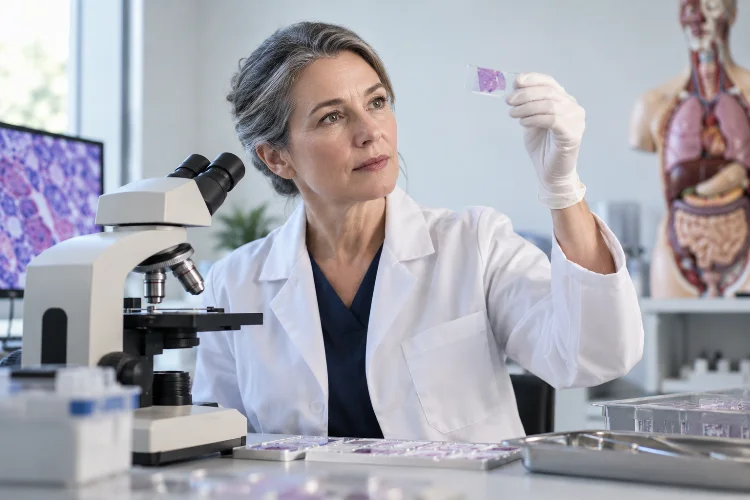
When someone develops a disease, the first questions are usually simple: What caused it? What is happening inside the body? And why does it produce certain symptoms?
Pathology helps answer all three.
Rather than looking only at how a patient feels, pathology studies the changes occurring in cells, tissues, organs, blood, and other body systems. It connects the original cause of a disease with the biological processes that follow and, eventually, with the symptoms doctors can observe.
Understanding how pathology explains the causes and effects of disease makes medicine much easier to understand.
An infection, for example, is not simply a microorganism entering the body. The pathogen can injure cells, trigger an immune response, produce inflammation, alter tissue function, and cause symptoms such as fever or pain.
Pathology follows this entire chain of events. It helps healthcare professionals understand why disease develops, how it progresses, what damage it produces, and how laboratory or tissue findings can guide diagnosis and treatment.
What Is Pathology?
Pathology is the scientific study of disease, particularly the causes, mechanisms, and structural or functional changes associated with illness.
In practical medicine, pathologists examine tissues, cells, blood, and other biological samples to identify abnormalities.
Microscopic examination of tissues, for example, can reveal whether cells appear normal, inflamed, damaged, infected, or cancerous. The National Cancer Institute describes pathologic diagnosis as identifying disease by examining cells and tissues under a microscope.
However, pathology goes beyond simply identifying abnormal cells. It tries to connect several important questions: what caused the disease, how that cause produced biological changes, what happened to the affected tissue, and how those changes influence the patient.
You can think of pathology as the bridge between basic biology and clinical medicine.
Pathology Starts by Looking for the Cause of Disease
The cause of a disease is known as its etiology. Some diseases have one relatively clear cause, while others develop through a combination of genetic, environmental, behavioral, and biological factors.
Infectious diseases may be caused by bacteria, viruses, fungi, or parasites. Other illnesses can result from toxins, physical trauma, inadequate oxygen supply, immune reactions, inherited mutations, nutritional problems, or long-term metabolic abnormalities.
Cell injury provides a useful example. Biological tissue can be damaged by hypoxia, chemicals, infections, physical agents, or inappropriate immune responses. If the injury becomes severe enough, cells may lose their ability to maintain normal function and eventually die.
Sometimes several causes interact. Cardiovascular disease, for instance, may be influenced by genetics, blood pressure, cholesterol, smoking, diet, metabolic health, and other factors rather than one seperate trigger.
Finding the cause is only the beginning. Pathology also asks what happens next.
Pathogenesis Explains How Disease Develops
The biological sequence between the original cause and the final disease is called pathogenesis.
Imagine that blood flow to part of the heart suddenly becomes blocked. Reduced blood supply means heart muscle cells receive less oxygen. Without enough oxygen, cellular energy production falls, important cellular processes begin to fail, and severe injury may eventually cause cell death.
That sequence explains more than simply saying that a patient had a heart attack.
The same principle applies to infections. A microorganism may enter tissue, reproduce, injure cells, and activate immune defenses. Those defenses may help destroy the pathogen, but they can also contribute to swelling, discomfort, fever, and tissue damage.
By understanding pathogenesis, doctors can identify points where treatment may interrupt the disease process rather than simply treating symptoms.
Cell Injury Is a Major Part of Disease
Many diseases eventually affect the body at the cellular level.
Cells constantly try to maintain a stable internal enviroment. They regulate energy production, water balance, proteins, ions, waste products, and countless chemical reactions. When stress becomes excessive, normal cellular balance can break down.
Mild injury may be reversible. If the harmful stimulus disappears quickly enough, the cell may recover. Severe or prolonged injury can result in irreversible damage and cell death.
One form of cell death is necrosis, which is associated with loss of membrane integrity and release of cellular contents into surrounding tissue. Necrosis can occur after severe oxygen deprivation, toxic injury, infections, and other damaging processes.
Another process is apoptosis, a tightly regulated form of programmed cell death. Unlike necrosis, apoptosis allows cells to be dismantled in a controlled way and generally produces much less inflammation in surrounding tissue.
These microscopic events can eventually create very visible clinical effects.
Inflammation Shows How the Body Responds to Injury
Inflammation is one of the body’s most important responses to tissue damage.
When cells detect infection, trauma, toxins, or other harmful conditions, chemical signals activate immune cells and blood vessels. Blood flow may increase, vascular permeability can change, and immune cells move toward the damaged area.
This process produces familiar signs such as redness, warmth, swelling, pain, and sometimes reduced function. Acute inflammation can help remove harmful agents and begin tissue repair.
The problem appears when inflamation becomes excessive or fails to resolve.
Persistent inflammatory activity can contribute to ongoing tissue damage and is involved in many chronic conditions.
In this way, pathology explains an interesting paradox: the same biological response that protects the body can also become part of a disease process when poorly controlled.
Structural Changes Lead to Functional Changes
One of the central ideas in pathology is that changes in structure often affect function.
Consider the lungs. Healthy lung tissue is designed to move oxygen efficiently between inhaled air and the bloodstream. If pneumonia causes inflammation and fluid accumulation within parts of the lungs, normal gas exchange becomes more difficult.
The patient may then experience coughing, shortness of breath, fatigue, or low oxygen levels.
A similar relationship occurs in kidney disease. Damage to structures responsible for filtering blood can reduce the kidneys’ ability to remove waste and control fluid balance.
This connection between morphology, meaning changes in the appearance or structure of cells and tissues, and physiological function helps explain why different diseases produce different symptoms.
Pathology Helps Turn Symptoms Into a Diagnosis
Symptoms provide clues, but symptoms alone do not always identify the underlying disease.
Fatigue, for example, can occur with infections, anemia, endocrine disorders, autoimmune disease, cancer, sleep problems, and many other conditions.
Doctors therefore combine symptoms with medical history, physical examination, laboratory testing, imaging, and sometimes biopsies.
Pathologists play an especially important role when cells or tissues need to be examined directly.
A biopsy may be inspected macroscopically and under a microscope. Additional molecular, genetic, or immunologic tests can sometimes provide further information.
In cancer care, pathology reports may identify the tumor type, grade, lymph-node involvement, surgical margins, molecular features, and other characteristics that influence treatment planning.
This makes pathology far more than a laboratory specialty hidden behind the scenes. Its findings can have a signficant impact on major clinical decisions.
Pathology Also Explains Disease Progression and Complications
Diseases rarely remain completely unchanged.
Some resolve quickly, while others progress gradually over months or years. Pathology helps explain why these different outcomes occur by examining continuing tissue injury, repair, immune responses, genetic changes, scarring, and organ dysfunction.
Repeated liver injury, for example, can trigger cycles of cell damage and repair. Over time, excessive scar tissue may interfere with the normal architecture and function of the organ.
Cancer provides another example. Abnormal cells can accumulate additional molecular changes, multiply, invade surrounding tissues, and sometimes spread to distant organs.
Understanding disease progression allows clinicians to estimate possible outcomes, watch for complications, and decide when intervention is necessary. Pathological findings can also reveal whether treatment is working or whether the disease has changed over time.
Why Understanding Pathology Matters
Pathology gives medicine a logical framework.
Instead of seeing fever, swelling, pain, abnormal laboratory results, or organ failure as isolated problems, pathology connects them into a biological story.
That story often follows a basic sequence:
Cause → cellular response → tissue changes → altered organ function → symptoms and complications.
The actual process can be much more complicated, but this framework makes many diseases easier to understand.
It also explains why modern medicine increasingly combines traditional tissue examination with molecular biology, genetics, immunology, and laboratory testing.
The more accurately healthcare professionals understand the mechanism behind a disease, the more precisely they can diagnose, classify, monitor, and sometimes treat it.
Pathology explains disease by connecting its cause with the biological changes that occur inside the body. It examines everything from cell injury and inflammation to tissue damage, organ dysfunction, disease progression, and clinical symptoms.
Understanding how pathology explains the causes and effects of disease also shows why diagnosis involves more than simply recognizing symptoms. Doctors need to understand what biological process is producing those symptoms and how far that process has progressed.
Whether the condition involves infection, cancer, immune dysfunction, oxygen deprivation, or another form of injury, pathology helps reveal the story happening beneath the surface.
If you want to understand medicine more deeply, learning basic pathology is an excellent next step. Start with cell injury, inflammation, healing, and disease mechanisms, then explore how these processes affect individual organs.