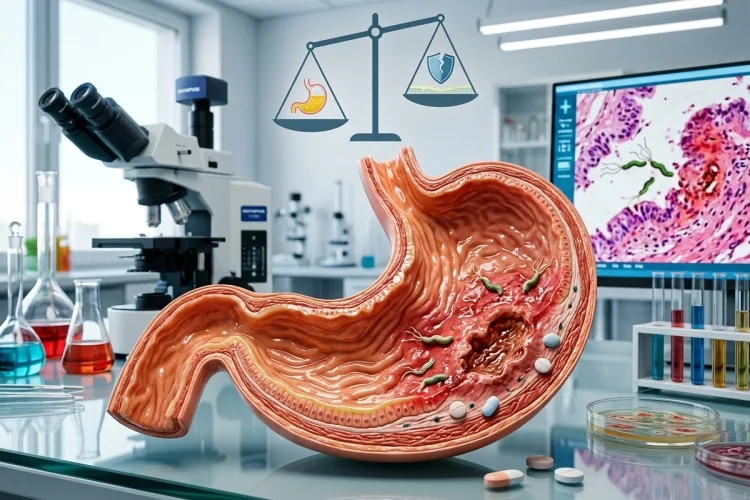
The stomach has an unusual job. It produces strong acid and digestive enzymes that help break down food, yet it must protect its own tissues from those same chemicals every day.
Normally, a specialized stomach lining, or gastric mucosa, keeps this aggressive environment under control.
Mucus, bicarbonate, healthy blood flow, and tightly connected epithelial cells create a defensive barrier between stomach acid and deeper tissue. Problems begin when that protection becomes weakened.
This is where gastritis and ulcers enter the picture. Gastritis involves inflammation of the stomach lining, while a gastric ulcer is a deeper open sore that develops when mucosal injury extends beyond the superficial surface.
Common causes include Helicobacter pylori infection and nonsteroidal anti-inflammatory drugs, or NSAIDs.
Understanding how gastritis and ulcers damage the stomach lining becomes easier when you see them as a balance problem: aggressive factors such as acid and inflammation begin overpowering the stomach’s protective mechanisms.
How the Healthy Stomach Protects Itself
Hydrochloric acid is useful for digestion, but it can also damage living tissue. The stomach therefore needs several layers of protection.
Surface epithelial cells produce mucus and bicarbonate, creating a protective environment near the mucosal surface.
Healthy blood flow helps deliver oxygen and nutrients while removing harmful substances, and the epithelial lining can normally repair minor surface injury relatively quickly.
This protection allows the stomach to contain acidic digestive contents without essentially digesting itself.
The important idea is that acid alone does not usually create an ulcer. Damage becomes more likely when the mucosal defense system is weakened, allowing acid, pepsin, inflammation, and other damaging influences to affect deeper tissue.
Merck describes gastritis and peptic ulcer disease as disorders involving damage to the stomach or duodenal lining in an acidic digestive environment.
What Happens During Gastritis?
Gastritis refers to inflammation of the gastric mucosa. It may develop rapidly as acute gastritis or persist over time as chronic gastritis.
When the stomach lining becomes inflamed, epithelial cells can become injured and the normal protective barrier becomes less effective. Blood vessels may become congested, inflammatory cells may enter the mucosa, and superficial damage can develop.
Some people experience upper abdominal discomfort, nausea, vomiting, or a feeling of fullness. Others may have surprisingly few symptoms even when inflammation is present.
Gastritis also does not automatically mean that an ulcer exists.
Inflammation may remain relatively superficial. However, persistent or severe injury can lead to erosions, bleeding, or eventually deeper mucosal defects. NIDDK notes that H. pylori gastritis and reactive gastropathy related especially to NSAID use can increase the likelihood of peptic ulcers.
How H. pylori Damages the Gastric Mucosa
One of the most important causes of chronic gastritis and peptic ulcer disease is Helicobacter pylori, commonly called H. pylori. NIDDK identifies H. pylori infection as one of the two most common causes of peptic ulcers.
This bacterium can survive in the harsh environment of the stomach by living close to the protective mucous layer.
Its presence triggers a persistent immune and inflammatory response. Over time, this inflammation can interfere with normal mucosal defenses and alter the balance between acid production and tissue protection.
The key process can be simplified as:
H. pylori infection → chronic inflammation → weakened mucosal protection → greater exposure to acid and pepsin → ulcer risk
Not every person with H. pylori develops an ulcer, but the organism creates biological conditions that make mucosal injury more likely.
Chronic infection can also produce longer-term changes in the gastric mucosa, which is one reason detecting and treating clinically significant H. pylori infection matters.
How NSAIDs Weaken the Stomach’s Protective Barrier
Common pain medicines can also damage the stomach.
NSAIDs, including medicines such as aspirin, ibuprofen, and naproxen, are another major cause of peptic ulcers. They can cause both acute and chronic gastric injury.
These medicines reduce the production of prostaglandins by inhibiting cyclooxygenase enzymes.
Prostaglandins normally support several protective functions in the stomach, including mucus and bicarbonate production and adequate mucosal blood flow. When prostaglandin activity decreases, those defenses become less effective.
The stomach is then more vulnerable to its own acidic environment.
This explains why long-term NSAID exposure can cause reactive gastropathy, erosions, and ulcers even without H. pylori infection. NIDDK notes that NSAID-associated gastric injury may require medication changes and, in some patients, acid-suppressing treatment.
From Superficial Erosion to a Deeper Ulcer
Not every break in the stomach lining is technically an ulcer.
A superficial mucosal defect is generally described as an erosion. An ulcer is deeper and extends farther into the wall.
Once the protective epithelium is lost, gastric acid and digestive enzymes can directly reach exposed tissue. Continued chemical injury and inflammation enlarge the defect, while damaged blood vessels and connective tissue may become exposed.
A gastric ulcer therefore represents much more than surface irritation.
Peptic ulcers are open sores in the stomach or duodenal lining, and the most common causes remain H. pylori and NSAID use.
One useful pathology sequence is:
Mucosal defense failure → epithelial injury → erosion → deeper tissue damage → ulcer
The actual process can vary between patients, but this framework makes the progression easier to understand.
Why Ulcers Can Cause Pain and Bleeding
Once an ulcer extends into deeper tissue, several complications become possible.
Inflamed and exposed tissue can contribute to burning or aching upper abdominal discomfort. Many patients describe peptic ulcer pain as burning or gnawing, although symptoms vary and some ulcers remain silent.
Bleeding becomes more serious.
If the ulcer erodes into a blood vessel, blood may enter the gastrointestinal tract. Depending on the amount and location, a patient might develop dark stools, vomiting of blood, anemia, weakness, or other signs of blood loss.
An ulcer can also penetrate completely through the stomach or duodenal wall, producing perforation. NIDDK lists bleeding, perforation, penetration into nearby structures, and obstruction among important complications of peptic ulcers.
This shows why a small-looking mucosal lesion can become clinically dangerous when it extends deeper.
Gastritis and Ulcers Are Not Simply Caused by Spicy Food
One persistent misconception is that spicy food causes peptic ulcers.
Current medical guidance identifies H. pylori infection and NSAID use as the major causes, not spicy meals. Stress and spicy foods may make symptoms worse in some people, but they are not considered the main causes of typical peptic ulcer disease.
Alcohol can irritate the gastric lining and contribute to reactive gastropathy, while smoking is associated with greater peptic-ulcer risk and may interfere with healing.
For medical learners, separating causes from symptom triggers is important.
Someone may notice pain after coffee, alcohol, or spicy food, but that does not necessarily reveal the underlying pathology.
How the Stomach Lining Heals
The gastric mucosa has substantial capacity for repair when the harmful stimulus is removed.
Superficial epithelial injury can often recover as cells migrate, proliferate, and restore the protective surface. Deeper ulcers require more extensive repair involving granulation tissue, extracellular matrix deposition, and remodeling.
Successful healing also depends on addressing the cause.
For H. pylori-associated ulcers, treatment generally includes eradication of the infection. When NSAIDs are responsible, clinicians may consider stopping them, reducing exposure, changing medications, or using acid-suppressive therapy depending on the clinical situation.
Reducing gastric acidity also gives damaged mucosa a better environment in which to heal.
That is why treatments such as proton pump inhibitors are commonly used in the management of peptic ulcer disease.
A Simple Way to Understand Gastritis and Ulcer Formation
For pathology learners, the entire process can be remembered as a competition between aggressive factors and defensive factors.
Aggressive factors include gastric acid, pepsin, H. pylori-associated inflammation, and certain medications.
Defensive factors include mucus, bicarbonate, mucosal blood flow, epithelial integrity, prostaglandins, and tissue repair.
When protection remains strong, the stomach tolerates its acidic environment.
When protection becomes insufficient, the sequence may progress toward:
Barrier weakness → inflammation → epithelial injury → erosion → ulcer → bleeding or perforation
This model helps connect cellular pathology with the symptoms and complications seen in patients.
Gastritis and ulcers damage the stomach lining when the balance between aggressive digestive forces and mucosal protection begins to fail. Gastritis starts with inflammation or injury of the gastric mucosa, while an ulcer represents a deeper break in that protective lining.
Two of the most important causes are H. pylori infection and NSAID use, both of which can weaken normal defenses and make tissue more vulnerable to acid and digestive enzymes.
Most importantly, remember the sequence rather than memorizing isolated terms: protective barrier fails, inflammation develops, tissue becomes exposed, and deeper injury can follow.
When studying gastric disease, ask which protective mechanism has been disrupted. That question makes the pathology of gastritis and peptic ulcers much easier to understand.